
Masking: When fitting in takes more than people see
masking social frictionMasking: When fitting in takes more than people see
Understanding the effort that can hide behind looking comfortable.

Long before we have words for how our brains work, we want to know that there is a place for us.
We want to be included. To have someone save us a seat. To feel that the people we love enjoy having us around.1
For some exceptionally wired women, knowing we were different came long before understanding why. We learned to watch, rehearse, adjust. Over time, fitting in could begin to mean making certain parts of ourselves less visible.2
What is masking?
Masking means concealing or adjusting parts of how we naturally express ourselves to meet social expectations.3
If someone shared this article with you, she may be offering words for something she experiences—and inviting you to understand what you haven’t been able to see.
One moment. Two experiences.
Looking comfortable and feeling comfortable can be different kinds of information.
“She seems so at ease.”
She asks questions, follows the conversation, and seems to be enjoying herself.
Another layer of effort.
She may also be choosing when to speak, checking her expression, or holding back a need for a break.
These are possibilities, not assumptions. Her own experience is the place to begin.
Meanwhile, on the inside…
Alongside the conversation, thoughts like these may be running through her mind:
She can enjoy your company and still find the interaction demanding. She can be skilled at something that takes considerable effort.
She can be having a good time
and still need time to recover.
Making the invisible visible
The NeuroExceptional Model™ brings strengths, sensitivities, and struggles into the same picture—helping make sense of experiences that can otherwise feel confusing and unrelated.
Where does masking fit?
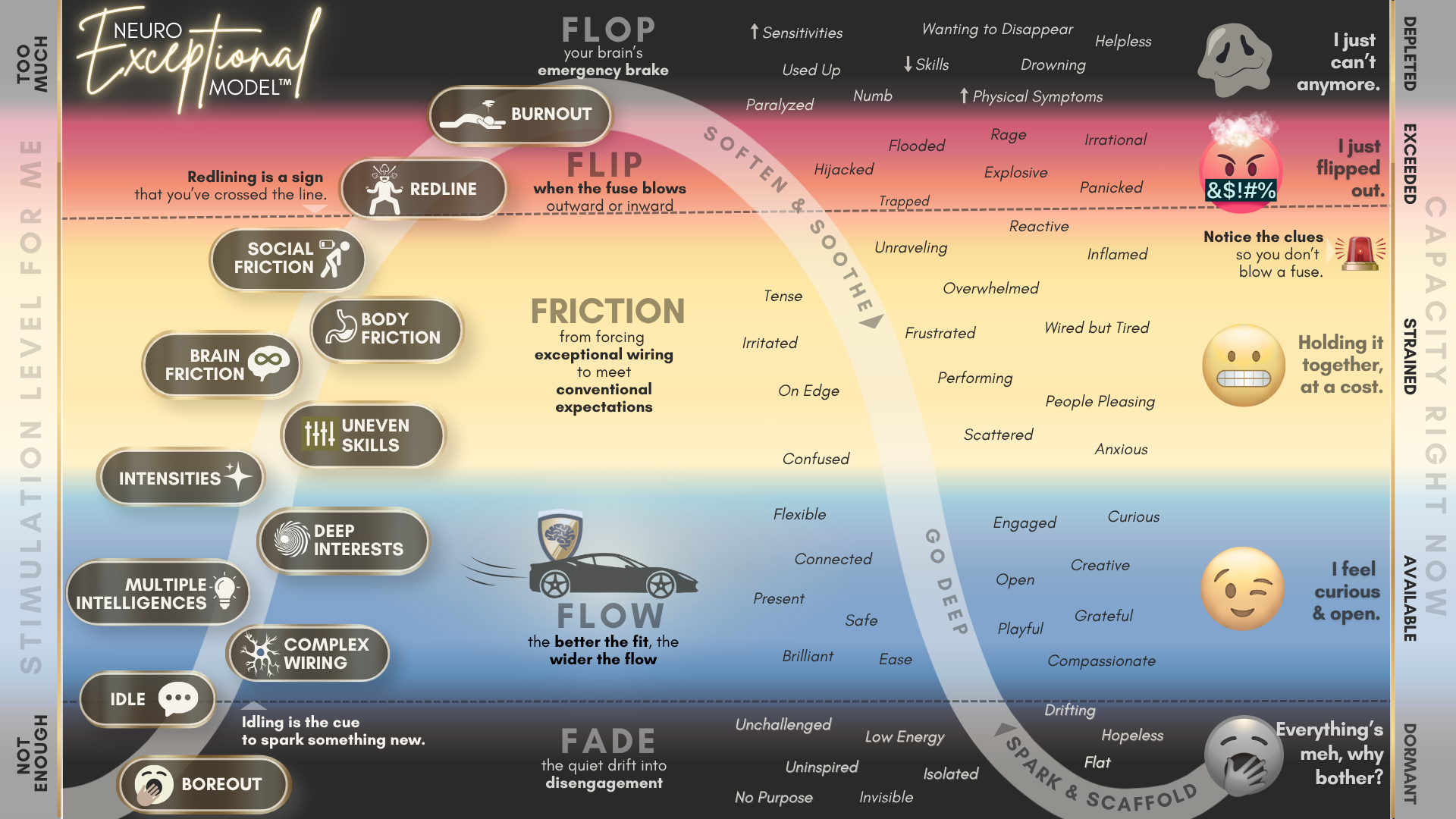
Social Friction is today’s access point in the yellow Friction area.
Masking
The work of concealing or adjusting parts of your natural expression to fit the situation. It may help you participate or protect your privacy, while adding effort that other people cannot see.
At the heart of the model is a simple idea: each brain difference comes with a strength and a rub.
The strength
Attentiveness can help her notice details, consider other people’s needs, and bring care to her relationships.
The rub
Continually checking the room and adjusting herself can take energy—especially when she is also holding back her own needs.
Small ways to make room.
Possibilities to explore together, starting with what feels helpful to her.
Believe her description of the effort.
Her capable appearance doesn’t tell you everything about her experience.
“Thanks for telling me. What would make this easier?”Make preferences easy to express.
A quieter place, a pause, or time to answer later may help.
“Would you rather talk while we walk?”Leave room for recovery.
Needing quiet after being together doesn’t necessarily mean anything went wrong between you.
“Would you like some company, or some time to yourself?”“Which part of this feels familiar to you?”
Then give her room to tell you.
A note about the research
Much of the research on masking and social camouflaging comes from studies of autistic people, including accounts from adults and women diagnosed later in life. These studies help illuminate experiences such as learning social strategies, seeking connection, and feeling exhausted by the effort.2, 3 Other research has included non-autistic adults and adults with ADHD, although some measures were developed specifically around autistic traits.4, 5
Recognizing an experience described here does not establish a diagnosis. Nor do these studies show that everyone who relates to it shares the same underlying mechanisms. Research linking camouflaging with mental-health difficulties is observational and does not, by itself, establish cause and effect.6
“Exceptionally wired” is the language I use to welcome readers, rather than a research diagnosis. The NeuroExceptional Model™, including its “strength and a rub” perspective, is my framework for exploring these experiences. Research can inform the concepts within it without validating the model as a whole. The examples of attentiveness, anticipation, and loneliness are possibilities for reflection, not traits established for every exceptionally wired woman. The practical suggestions are options to explore, rather than a tested intervention.
Research behind this article
1. Baumeister, R. F., & Leary, M. R. (1995). The need to belong: Desire for interpersonal attachments as a fundamental human motivation. Psychological Bulletin, 117(3), 497–529. https://doi.org/10.1037/0033-2909.117.3.497
2. Bargiela, S., Steward, R., & Mandy, W. (2016). The experiences of late-diagnosed women with autism spectrum conditions: An investigation of the female autism phenotype. Journal of Autism and Developmental Disorders, 46(10), 3281–3294. https://doi.org/10.1007/s10803-016-2872-8
6. Cage, E., & Troxell-Whitman, Z. (2019). Understanding the reasons, contexts and costs of camouflaging for autistic adults. Journal of Autism and Developmental Disorders, 49(5), 1899–1911. https://doi.org/10.1007/s10803-018-03878-x
3. Hull, L., Petrides, K. V., Allison, C., Smith, P., Baron-Cohen, S., Lai, M.-C., & Mandy, W. (2017). “Putting on my best normal”: Social camouflaging in adults with autism spectrum conditions. Journal of Autism and Developmental Disorders, 47(8), 2519–2534. https://doi.org/10.1007/s10803-017-3166-5
4. Hull, L., Mandy, W., Lai, M.-C., Baron-Cohen, S., Allison, C., Smith, P., & Petrides, K. V. (2019). Development and validation of the Camouflaging Autistic Traits Questionnaire (CAT-Q). Journal of Autism and Developmental Disorders, 49(3), 819–833. https://doi.org/10.1007/s10803-018-3792-6
5. van der Putten, W. J., Mol, A. J. J., Groenman, A. P., Radhoe, T. A., Torenvliet, C., Agelink van Rentergem, J. A., & Geurts, H. M. (2024). Is camouflaging unique for autism? A comparison of camouflaging between adults with autism and ADHD. Autism Research, 17(4), 812–823. https://doi.org/10.1002/aur.3099
